 >
> Quick Facts about Wildlife in Bwindi Impenetrable National Park
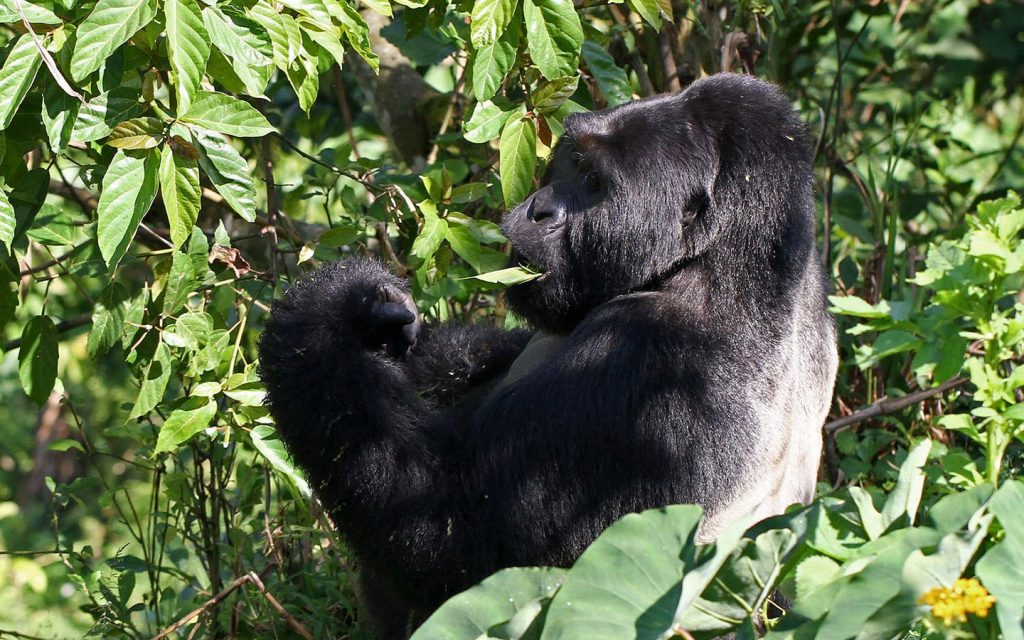
- 459 mountain gorillas – nearly half the global population
- 120 mammal species (including 11 primates)
- 350 recorded bird species (23 Albertine Rift endemics)
- 220 butterfly species (8 Albertine endemics)
- 27 frog species (11 endemic to the Albertine Rift)
- Elevation range: 1,160–2,607 metres above sea level
- Habitats: lowland and montane forest, bamboo zones, swamps, and steep valleys
About Bwindi Impenetrable National Park
Bwindi Impenetrable National Park is a breathtaking UNESCO World Heritage Site nestled in south-western Uganda along the edge of the Albertine Rift, often visited by tourists on Uganda gorilla tours.
Covering 321 km² of rugged mountains and dense montane forest ranging from 1,160 m to 2,607 m above sea level, this ancient rainforest has existed for over 25,000 years.
Gazetted as a national park in 1991 and declared a World Heritage Site in 1994, Bwindi protects almost half the world’s remaining critically endangered mountain gorillas alongside chimpanzees, forest elephants, 120 mammal species, rare birds, and rich biodiversity seen during safaris in Uganda.
Types of Animals You Can Meet in Bwindi Impenetrable National Park
Primates – The Stars of the Forest
Bwindi Impenetrable Forest is a primate paradise in Uganda, home to 11 different primate species – one of the richest collections in Africa. While mountain gorillas steal the show, keep your eyes open for these fascinating monkeys and nocturnal creatures swinging through the dense canopy during Uganda gorilla trekking tours or safaris in Uganda.
MOUNTAIN GORILLAS (GORILLA BERINGEI BERINGEI)
The undisputed stars of Bwindi and the main reason most visitors come -the Mountain Gorillas. These critically endangered gentle giants are the largest living primates – adult silverback males reach up to 1.7 m tall and weigh as much as 200 kg. Their jet-black fur is thicker than lowland gorillas to handle the cool mountain air.
They are peaceful herbivores, and they spend their days munching leaves, bamboo shoots, and wild fruits. Twenty-five habituated gorilla families (25) allow visitors to spend a magical hour watching them play, feed, and rest in their natural habitat during gorilla trekking safaris in Uganda or Uganda gorilla tours.
EASTERN CHIMPANZEES (PAN TROGLODYTES SCHWEINFURTHII)
Bwindi is the only place in the world where you can see both mountain gorillas and chimpanzees in the same park. Over 400 chimps live here, though they remain wild and unhabituated, so sightings are rare and exciting. With long arms, black faces, and dark coats, these knuckle-walkers share nearly 99% of human DNA. Listen for their loud pant-hoots echoing through Buhoma valley – a true wild Africa soundtrack during Uganda tours.
L’HOEST’S MONKEYS (CERCOPITHECUS LHOESTI)
Also known as mountain monkeys, these shy beauties have dark brown-black fur with a striking white bib across the chest and throat. A reddish-brown saddle on their back makes them stand out. They prefer foraging on the forest floor in small family groups led by one male. Often spotted along trails in Buhoma and Ruhija sectors during nature walks or gorilla treks in Bwindi Impenetrable National Park.
BLACK-AND-WHITE COLOBUS MONKEYS (COLOBUS GUEREZA)
Easily the most photogenic monkeys in Bwindi! Their glossy black fur contrasts dramatically with long white mantles flowing from their shoulders and a bushy white tail. Newborns are born pure white and gradually turn black.
These leaf-eating specialists leap gracefully through the canopy with spectacular airborne displays. Frequently seen along forest trails during Uganda trips, especially in Buhoma, their deep roaring calls are unforgettable.
RED-TAILED MONKEYS (CERCOPITHECUS ASCANIUS)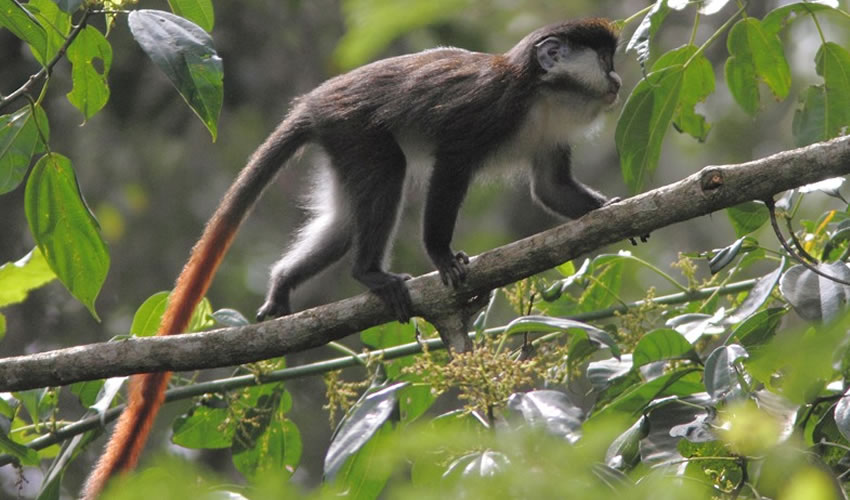
Cheeky and energetic, these medium-sized guenons have olive-brown bodies, black limbs, and a distinctive copper-red tail. White cheek whiskers and a heart-shaped white nose spot add character. They travel in large, noisy troops of 20–40, constantly chattering and crashing through the trees. Common along the Muzubijiro Loop trail in Ruhija – you’ll definitely hear them before you see them!
OLIVE BABOONS (PAPIO ANUBIS)
Large, powerful, and highly social, olive baboons have dog-like muzzles and thick grey-green fur that gives an olive sheen from a distance. Troops of 20–100 individuals roam near park headquarters and villages. Highly intelligent and bold, they walk on all fours with a distinctive hunched posture. Babies ride on their mothers’ backs like little jockeys – a favourite sight for visitors on Uganda safari tours.
BLUE MONKEYS (CERCOPITHECUS MITIS)
Despite the name, they’re not blue! The “blue” refers to a subtle bluish tint on their face and limbs under certain light. Their coat is actually grey-olive with black arms, legs, and crown. These arboreal monkeys live in female-dominated groups and are often seen feeding quietly in mid-canopy. Look for them along forest edges and during nature walks in the Buhoma sector.
VERVET MONKEYS (CHLOROCEBUS PYGERYTHRUS)
Small, agile, and full of personality, vervets have silvery-grey bodies, black faces, hands, and feet, and a white band across the forehead. Males have striking, bright blue scrotums – nature’s boldest fashion statement! Highly adaptable, they’re often spotted near lodges and park headquarters raiding bins or escorting gorilla groups through the forest. Entertaining and fearless around humans.
POTTOS (PERODICTICUS POTTO)
These mysterious nocturnal primates look like tiny, slow-moving bears. With woolly grey-brown fur, huge eyes, and a short tail, pottos move deliberately along branches using strong gripping hands and feet. Their neck has spiny vertebrae for protection against predators. Only visible during guided night walks in Buhoma – a rare and magical encounter in the moonlit forest.
DEMIDOFF’S GALAGO (GALAGOIDES DEMIDOFF)
Africa’s smallest primate! Also called Demidoff’s bushbaby, these tiny, big-eyed creatures weigh just 60–80 grams. With long tails for balance and powerful hind legs for leaping.
Herbivores – The Shy Forest Dwellers
Bwindi’s thick montane forest hides some of Africa’s shyest plant-eaters. While mountain gorillas grab the spotlight, lucky visitors on nature walks may spot these elusive herbivores quietly browsing among the trees and swamps during Uganda safaris.
AFRICAN FOREST ELEPHANTS (LOXODONTA CYCLOTIS)
Smaller and darker than savannah cousins, forest elephants have straight downward-pointing tusks and rounded ears. Adults reach 2.5 m at the shoulder and weigh up to 3 tons. Extremely shy, they move silently through dense vegetation, leaving broken branches and large footprints as the main evidence of their presence in the Ruhija sector.
SITATUNGA (TRAGELAPHUS SPEKII)
This rare swamp-loving antelope has long, splayed hooves perfect for walking on floating vegetation. Males are chocolate-brown with white markings and spiral horns up to 90 cm long; females are lighter reddish-brown. They spend hot days resting on trampled reed platforms. Look for them near Mubwindi Swamp in Ruhija – they’re excellent swimmers when disturbed.
BUSHBUCK (TRAGELAPHUS SYLVATICUS)
Beautiful spiral-horned antelopes with reddish-brown coats and geometric white spots on hips, thighs, and neck. Males carry impressive horns up to 40 cm. Extremely wary and mostly solitary, they freeze or bark loudly when alarmed before dashing into thick cover. Often glimpsed during quiet morning walks along Buhoma trails during safaris in Uganda.
GIANT FOREST HOG (HYLOCHOERUS MEINERTZHAGENI)
The world’s largest wild pig – boars can weigh over 275 kg! Black-skinned with coarse, bristly hair, huge wart-like cheek swellings, and massive, curved tusks. They travel in family groups called sounders. Despite their size, these impressive creatures melt into Bwindi’s undergrowth and are very rarely seen by visitors.
COMMON WARTHOG (PHACOCHOERUS AFRICANUS)
Recognisable by their curved tusks, wart-covered faces, and mane along the spine. They kneel on front knees to dig for roots and bulbs. Though more common in savannah parks, small family groups sometimes wander into Bwindi’s lower edges and clearings, especially during the dry season.
BUSHPIG (POTAMOCHOERUS LARVATUS)
Reddish-brown wild pigs with pointed ear tufts, a white facial mask, and sharp tusks. Piglets have striking yellow stripes that fade with age. Nocturnal and aggressive when cornered, they live in sounders of up to 12 animals. You’ll more likely hear their grunts than see them in the Bwindi dense forest.
BLACK-FRONTED DUIKER (CEPHALOPHUS NIGRIFRONS)
Small (14–18 kg) forest antelopes are named for the distinctive black blaze running from nose to forehead. Rich chestnut-red coat with a slight crest along the back. Both sexes have short, spiked horns. Secretive but often seen darting across Buhoma trails at dawn or dusk.
WEYNS’S DUIKER (CEPHALOPHUS WEYNSI)
Slightly larger than black-fronted duikers, with plain rufous coats and tiny straight horns hidden in a hair tuft. They live alone or in small family groups and are active both day and night. Quiet visitors doing nature walks in the Buhoma sector sometimes spot these elegant little antelopes feeding on fallen fruit.
SQUIRRELS (SCIURIDAE FAMILY)
Bwindi hosts several colourful species, including Carruthers’s mountain squirrel, Boehm’s bush squirrel, Rwenzori sun squirrel, and red-legged sun squirrel. With their bushy tails and acrobatic leaps, they add constant movement and chatter to the forest canopy – a delight to watch while waiting for habituated gorilla families to appear during gorilla trekking tours in Bwindi.
Carnivores – Masters of Stealth
Deep inside Bwindi’s thick forest live some of Africa’s sneakiest meat-eaters. These nocturnal hunters are masters of stealth – you’ll need plenty of luck (and maybe a night walk) to spot them!
SIDE-STRIPED JACKAL (LUPULELLA ADUSTA)
A slender, grey-coated canine (6–14 kg) with a faint white-tipped tail and subtle side stripe. More omnivorous than other jackals, it eats fruit, insects, rodents, and carrion. Usually seen in monogamous pairs. Very shy in Bwindi – a rare glimpse during early morning or dusk nature walks in Buhoma.
AFRICAN GOLDEN CAT (CARACAL AURATA)
Twice the size of a domestic cat (5–16 kg), with beautiful golden-red, grey, or melanistic coats and faint spots on the belly and legs. One of Africa’s most secretive felines, active day and night. Extremely rare to see in Bwindi’s dense undergrowth – camera traps occasionally catch these rainforest ghosts.
AFRICAN CIVET (CIVETTICTIS CIVETTA)
Large (8–20 kg), strikingly patterned with black-and-white bands and spots on grey-brown fur, plus a dramatic erectile dorsal crest. Famous for the strong-smelling musk (civetone) used in perfumes. Strictly nocturnal and solitary. You might smell one before you see it, hiding in thick vegetation during night walks.
HONEY BADGER / RATEL (MELLIVORA CAPENSIS)
Fearless and stocky (8–16 kg) with a trademark black body and silver-grey “cape” from head to tail. Thick loose skin and powerful claws make it almost invincible – even lions give them space! Eats anything from bees and honey to snakes and small antelopes. A very rare and thrilling sighting in Bwindi National Park.
AFRICAN CLAWLESS OTTER (AONYX CAPENSIS)
The second-largest freshwater otter (10–21 kg), sleek brown with a creamy white face, chest, and long sensitive whiskers. Almost no claws on front feet – uses dextrous fingers to feel for crabs and fish. Playful and mostly crepuscular. Look along the River Ivi during nature walks – their joyful splashing is unforgettable when spotted!
Amphibians in Bwindi Impenetrable National Park
Bwindi’s misty streams, swamps, and damp forest floor create perfect homes for 27 amphibian species – 11 of them found nowhere else but the Albertine Rift. After rain, the forest comes alive with their calls.
FROGS
Bwindi hosts a colourful chorus of tree frogs and reed frogs. Look for bright green Cinnamon-bellied Reed Frogs, golden-brown Ahl’s Reed Frogs, and the rare Kivu Reed Frog. Many are tiny (2–5 cm), perfectly camouflaged on leaves or reeds, and explode into deafening song at night.
TOADS
Chunky, warty-skinned toads with short legs hop quietly through leaf litter. Their dry, leathery skin helps them survive away from water longer than most frogs. You’ll usually hear their low croaks or spot them crossing trails after dusk – true masters of the dark forest floor.
SALAMANDERS
Rare, secretive, and almost never seen by visitors, Bwindi’s few salamander species have smooth, moist skin and long tails. They hide under logs and rocks in the coolest, wettest parts of the park, emerging only on rainy nights – mysterious survivors from an ancient lineage.
Reptiles in Bwindi Impenetrable National Park
Bwindi’s cool, damp forest hides a fascinating collection of reptiles. Thanks to the thick vegetation, sightings are rare – but when they happen, they’re magical!
SNAKES
From the stunning emerald-green Great Lakes Bush Viper with its zigzag black markings to harmless Günther’s Green Tree Snake and the highly venomous African Tree Cobra, Bwindi hosts many species. Most are shy and arboreal – you’re more likely to spot one draped across a branch during a quiet trek.
CHAMELEONS
Masters of camouflage! Look for the iconic Three-Horned Chameleon (males boast three dramatic horns) and the beautiful Montane Side-Striped Chameleon with its serrated back ridge. They move slowly along branches, eyes swivelling independently, changing colour with mood or temperature – a true highlight on nature walks.
LIZARDS
Fast-moving forest lizards dart across trails and tree trunks. The Sparse-Scaled Forest Lizard blends perfectly with bark, while colourful agamas flash bright throats when basking on sunlit leaves. Keep your eyes peeled near streams and clearings – they vanish in seconds!
SKINKS
Shiny, smooth-scaled skinks like the Speckle-lipped Mabuya and African Striped Skink rustle through leaf litter hunting insects. Their long bodies and short legs give them a snake-like appearance, but watch the quick flick of their blue tails – a classic skink giveaway!
GECKOS
Delicate house geckos and the striking Uganda Blue-Headed Tree Agama (males show electric-blue heads in breeding season) cling to tree trunks and lodge walls. At night, you’ll hear their clicking calls echoing through the forest – tiny dragons of Bwindi’s trees.
Why the Wild Animals in Bwindi Impenetrable National Park Matter So Much?
Bwindi’s incredible wildlife – from mountain gorillas to tiny frogs – is far more than just beautiful creatures to see. They are the beating heart of one of Africa’s most important ecosystems and a global conservation treasure.
- Guardians of the Ancient Forest: Forest elephants, gorillas, monkeys, and duikers act as ecosystem engineers, dispersing seeds of giant hardwood trees and keeping the montane forest healthy and regenerating for future generations.
- Home to Almost Half the World’s Mountain Gorillas: Bwindi protects nearly half the planet’s remaining critically endangered mountain gorillas – making it a true sanctuary and one of the greatest conservation success stories on Earth.
- Global Biodiversity Hotspot: With 120 mammal species, 350 birds (23 Albertine Rift endemics), 220 butterfly species, rare reptiles and amphibians, Bwindi is recognised as a UNESCO World Heritage Site for its outstanding natural value.
- Nature’s Medicine Cabinet & Climate Change Fighters: Many plants and animals here (especially frogs) hold compounds used in modern medicine, while the forest and its creatures help fight climate change by storing massive amounts of carbon.
- Economic Lifeline Through Tourism: Bwindi Gorilla trekking and wildlife tourism bring millions of dollars that directly fund anti-poaching patrols, park management, and community projects – turning conservation into real jobs and income.
- Bridge Between People and Nature: Revenue-sharing supports local communities, schools, clinics, and projects like the Batwa cultural experience, creating strong local support for protecting these animals instead of poaching them.
- Scientific Treasure Trove: Researchers from around the world study Bwindi’s restricted-range species, endemic frogs, rare birds, and primate behaviour – knowledge that helps protect wildlife everywhere.
In short, every gorilla family, every African green broadbill, and every hidden chameleon plays an irreplaceable role. When you visit Bwindi and buy a gorilla permit, you’re not just seeing animals – you’re actively helping save one of the wild world’s last great refuges of animals.
Best Ways to See Bwindi’s Animals
These are the most rewarding Uganda Wildlife Authority-approved activities to meet Bwindi’s incredible wildlife up close:
Mountain Gorilla Trekking

The world-famous adventure everyone dreams of! Hike through ancient montane forest with expert rangers to find one of 25 fully habituated gorilla families during gorilla tours in Uganda. After 2–8 hours of trekking, spend a magical hour watching these gentle giants feed, groom, and play – an almost 100% success rate in Buhoma, Ruhija, Rushaga, or Nkuringo sectors.
Gorilla Habituation Experience
Exclusive to the Rushaga sector and limited to just 4 visitors per day. Join researchers for up to 4 unforgettable hours with a wild gorilla family still getting used to humans. More time, more natural behaviour, and perfect photo opportunities with the critically endangered mountain gorillas in their natural habitat are what this activity offers.
Birding
Bwindi is Africa and East Africa’s number-one birding hotspot according to the Africa Birding Club, with 350+ species and 23 Albertine Rift endemics. Early-morning guided walks in Ruhija and along Mubwindi Swamp deliver sightings of rare gems like African green broadbill, Shelley’s crimsonwing, Lagden’s bush-shrike, Chapin’s flycatcher, and handsome francolin – a paradise for serious birders on a Uganda birding safari.
Nature Walks
The best way to discover Bwindi’s hidden wildlife. Guided forest trails reveal troops of black-and-white colobus, L’Hoest’s and blue monkeys, duikers, giant forest hogs, forest elephant signs, colourful butterflies, and stunning waterfalls. Popular routes are the Munyaga River Trail, Muzubijiro Loop, and Ivy River Trail for possible clawless otter sightings.
Mountain Biking
An exciting, active option on community trails around the park’s edge. Cycle through villages and farmland while spotting olive baboons, vervet monkeys, and numerous bird species. The fresh air and gentle hills make it a fun way to experience Bwindi’s rich biodiversity outside the dense forest.
Batwa Cultural Experience
Walk with the Batwa – the forest’s original inhabitants – along secret trails they used for centuries. Learn traditional hunting and gathering techniques while spotting monkeys, duikers, and rare birds. A beautiful blend of culture and wildlife that supports local communities and conservation.
Best Time to Visit Bwindi for Wildlife Viewing
The dry seasons – June to August and December to February – offer the easiest trekking conditions with drier trails and less rain. Gorillas are slightly easier to track because they stay at lower elevations. However, the forest is beautiful year-round, and the “low” seasons (March–May & September–November) have fewer visitors and lower lodge rates. Rain often falls in short afternoon bursts, leaving mornings clear.
Visitor Guidelines – Help Protect Bwindi’s Animals and Keep Everyone Safe
Your actions make a huge difference in protecting Bwindi Impenetrable National Park’s rare mountain gorillas, endangered primates, forest elephants, and rich biodiversity. Please follow these simple Uganda Wildlife Authority rules every time you visit this UNESCO World Heritage Site.
- Keep a Safe Distance – At Least 7 Metres from Gorillas: Stay 7 metres (10 metres if you have a cold or cough) from the habituated gorilla families. This protects the critically endangered gentle giants from human diseases and keeps you safe, too.
- No Flash Photography Ever: Flash startles gorillas, monkeys, and other wildlife. It can cause stress or dangerous reactions. Use natural light only during your magical hour with the gorillas.
- Move Slowly and Speak Softly: Sudden movements or loud voices disturb mountain gorillas, L’Hoest’s monkeys, black-and-white colobus troops, and shy forest creatures. Quiet respect lets them behave naturally.
- Take All Rubbish with You: Even a tiny piece of plastic can harm duikers, birds, butterflies, or frogs. Pack everything out – leave only footprints in the ancient montane forest.
- Never Feed Any Animal: Feeding wildlife (even monkeys or baboons) makes them lose their fear of humans, damages their health, and can turn them aggressive. It may even lead to them being destroyed for safety.
- Always Follow Your Ranger’s Instructions: Experienced UWA rangers and trackers know the forest, gorilla families, and every creature’s behaviour. Listening to them keeps you safe and protects Bwindi’s wildlife.
- Start Early – Most Animals Are Active at Dawn: Gorilla trekking begins at 8 am because mountain gorillas, red-tailed monkeys, blue monkeys, and birds are most active in the cool morning hours.
- Use Binoculars or Zoom Lenses: Get amazing close-up views of rare birds like the African green broadbill, shy duikers, or distant gorilla families without ever getting too close.
By following these easy rules, you help ensure that Bwindi Impenetrable Forest remains a safe sanctuary for almost half the world’s mountain gorillas and hundreds of other precious species – for generations to come. Thank you for being a responsible visitor!
Other Amazing Attractions in Bwindi Impenetrable National Park
Bwindi isn’t only about mountain gorillas and forest elephants – its breathtaking nature and living culture create an unforgettable experience.
Bird Species
Bwindi is one of Africa’s top birding destinations with over 350 recorded species, including 23 Albertine Rift endemics found nowhere else on Earth. Serious birders head to Ruhija and Mubwindi Swamp for magical sightings of African green broadbill, Shelley’s crimsonwing, Lagden’s bush-shrike, Chapin’s flycatcher, handsome francolin, and Grauer’s swamp warbler – a true paradise for feathers and binoculars!
The Batwa People
The Batwa are the original guardians of the forest, living in harmony with Bwindi’s mountains and creatures for centuries. Join their cultural experience to walk ancient hunting trails, learn traditional medicine from forest plants, taste wild honey, dance around campfires, and hear incredible stories of life alongside mountain gorillas – a moving, authentic encounter that directly supports this resilient community.
Flora of Bwindi
Step into a living cathedral of giant trees and tangled green. Bwindi’s ancient montane forest is packed with over 200 tree species, rare orchids, massive ferns, hanging lichens, and medicinal plants. Towering brown mahogany and strangler figs create cool, misty cathedrals of green. Nature walks reveal waterfalls, crystal streams, and carpets of moss – pure magic for plant lovers and photographers on a Uganda trip.
Serious Threats Facing Bwindi’s Precious Wildlife
Even this UNESCO World Heritage Site faces real dangers that put its mountain gorillas, forest elephants, rare birds, and rich biodiversity at risk:
- Human-Wildlife Conflict – Crop raids by bush pigs, baboons, and duikers along park boundaries create tension with local communities.
- Climate Change – Rising temperatures and changing rainfall patterns threaten the delicate montane forest ecosystem and food sources for gorillas and other species.
- Disease Transmission – Mountain gorillas share 98% of our DNA, making them extremely vulnerable to human colds, flu, and other illnesses carried by visitors.
- Past Poaching – Though now largely controlled thanks to strong patrols, illegal hunting once devastated gorilla and elephant numbers.
Ongoing Conservation Efforts – A True Conservation Success Story
Bwindi shows the world how conservation can work when everyone pulls together:
- Gorilla tourism revenue funds daily anti-poaching patrols by Uganda Wildlife Authority rangers and trackers.
- Community benefit programmes (schools, clinics, roads) mean local people now see gorillas as valuable neighbours instead of threats.
- Strict visitor rules (7-metre distance, no sick visitors on trek) protect the critically endangered mountain gorilla population.
- Habituation and monitoring by researchers help scientists understand and protect these gentle giants and the entire forest ecosystem.
- Revenue-sharing with Batwa and neighbouring communities has turned former poachers into proud conservation ambassadors.
Thanks to these combined efforts, Bwindi’s mountain gorilla numbers have steadily grown – now sheltering almost half the world’s remaining population. It’s living proof that responsible tourism and strong community partnerships can save even the most endangered species and keep the ancient Impenetrable Forest thriving for generations to come.
Other Incredible Uganda Safari Destinations for Animal Lovers
Explore more of Uganda’s amazing wildlife – here are the top Uganda national parks to add to your trip:
Murchison Falls National Park: Uganda’s largest park – famous for the dramatic Nile exploding through a narrow gorge. Spot lions, leopards, giraffes, buffalo, Uganda kob, elephants, hippos, crocodiles, and over 450 bird species on game drives and unforgettable boat safaris here.
Queen Elizabeth National Park: Some of the animals here include tree-climbing lions in Ishasha, huge elephant and buffalo herds, hippos, leopards, hyenas, Uganda kob, and 600+ bird species. Launch trips on Kazinga Channel offer one of Africa’s best wildlife spectacles. Perfect lion and elephant viewing all year.
Kibale National Park: The “Primate Capital of the World” – home to 13 primate species, including habituated chimpanzees, red colobus, L’Hoest’s, black-and-white colobus, blue and red-tailed monkeys, olive baboons, and nocturnal galagos. Amazing chimp tracking and swamp walks offer incredible sightings of most of the park’s animals.
Lake Mburo National Park: Closest savannah park to Kampala – perfect for zebras, impala, eland, topi, buffalo, hippos, crocodiles, leopards, and over 300 bird species. Enjoy walking safaris, horseback rides, and boat trips – the only park in Uganda with impala and zebra together.
Kidepo Valley National Park: Remote, wild, and breathtaking – ranked among Africa’s finest wildernesses. Huge lion prides, cheetahs, leopards, bat-eared foxes, ostriches, greater kudu, caracal, and 470+ bird species are some of the Uganda animals here, running in the vast golden plains with virtually no crowds.
Mgahinga Gorilla National Park: Small but spectacular – the Uganda side of the Virunga volcanoes. Track one habituated mountain gorilla family (Nyakagezi), golden monkeys, spot forest elephants, buffalo, and rare Albertine Rift birds in stunning volcanic scenery while on Uganda wildlife safaris here.

The only place in Uganda to see white rhinos in the wild! This community-run sanctuary has successfully reintroduced rhinos. Track them on foot with expert rangers – a perfect half-day stop between Kampala and Murchison Falls.
Pian Upe Wildlife Reserve: Uganda’s second-largest protected area – vast, untouched plains with cheetahs, leopards, lions, roan antelope, lesser kudu, bright’s gazelle, ostriches, and a huge bird list. Perfect for adventurous travellers seeking true wilderness during African safaris in Uganda.
Reputable Uganda Safari Companies Offering Uganda Animal Tours in Bwindi National Park
- Prime Safaris and Tours Ltd
- Wild Gorilla Safaris
- Safari Uganda Safaris
- Gorilla Safaris and Tours
- A Uganda Safari
- Africa Safaris Tours
- Uganda Birding Safaris
- Gorilla Trekking Uganda
- Kampala City Tour
- Self-Drive Car Hire Rentals Uganda
- Car Hire Rentals Uganda Kampala
Examples of the Bwindi National Park Tour Packages that provide tourists with animal sightings
- 3 Days Bwindi Gorilla Trekking Safari: Pure Mountain gorilla experience + forest monkeys & birds
- 4 Days Bwindi Gorillas + Kibale Chimps: Mountain gorillas + habituated chimpanzees in one short trip
- 5–6 Days Gorillas & Classic Wildlife: Bwindi gorilla trekking + Queen Elizabeth lions, elephants, hippos & boat safari
- 6 Days Double Primate Safari: Mountain gorillas in Bwindi + chimpanzees in Kibale + extra forest primates
- 10 Days Best of Uganda Safari: Gorillas, chimps, Queen Elizabeth big game, Kazinga Channel boat cruise & Lake Bunyonyi relaxation
Pick your desired length – every package guarantees gorilla sightings and heaps of other amazing Uganda animals!
Frequently Asked Questions About Uganda Animals in Bwindi Impenetrable National Park (FAQs)
What Is the Best Season to See Uganda’s Animals in Bwindi?
Viewing Uganda animals in Bwindi is good year-round, but at its best in the dry season.
During this season, trails are dry, and there are minimal chances of rainfall to inconvenience your activity.
Besides, June to August and December to February have the least rain, while March to mid-May has the most.
Heavy rains might interfere with your Gorilla trekking in Bwindi.
What Is the Best Time of The Day to See Animals in Bwindi?
The ideal time to see animals in Bwindi is in the morning. The morning session is the best because animals are getting out to feed.
In the same way, they tend to shelter in their nests in the thickness of the forests in the afternoon.
Therefore, as you plan a Uganda Gorilla safari in Bwindi, please keep that in mind.
What Are the Common Animals in Bwindi Impenetrable National Park?
Mountain Gorillas are the most common animals in Bwindi. They account for 99% of the visitors to this beautiful forest.
Bwindi is home to the biggest population of these giants in the world (459) and is the perfect place to encounter the majesty of Africa’s most sought-after primate.
How Many Animal Species Are in Bwindi Impenetrable National Park | What Animals Live in the Bwindi Rainforest?
Bwindi Impenetrable National Park has one of the biggest biodiversity in Uganda.
And therefore, if you are planning a Uganda tour, Bwindi should be among your top choices!
It’s home to over 120 mammal species, including over 10 primate species, counting over 459 Mountain Gorillas, Chimpanzees, Blue Monkeys, Red-tailed Monkeys, L’Hoest monkeys, Pottos, and Bush Babies, among others.
Other animals in Bwindi Impenetrable National Park include Forest Elephants, Giant Forest Hogs, Bush Pigs, Golden Cats, African civets, Side-Striped Jackals, Duikers, and Clawless Otters; however, these are rarely spotted.
Are There Elephants in Bwindi?
Yes, there are Elephants in Bwindi. However, they are very elusive. On your lucky day, you can spot these Forest Elephants in the Mubwindi swamp area in the Ruhija sector.
How Many Gorillas Are in Bwindi National Park? | How Many Gorillas Are in Bwindi?
Bwindi National Park is home to over 459 Mountain Gorillas. This is almost 50% of the 1,063 Mountain Gorillas in the world. Bwindi is therefore the best place for Uganda Gorilla trekking and, quite frankly, African safaris.
Are There Chimpanzees in Bwindi?
Yes! There are Chimpanzees in Bwindi Impenetrable National Park. The Chimpanzee population in Bwindi is estimated to be above 400. However, Uganda Chimps in Bwindi are not habituated, and so you are not guaranteed to see them.
However, if you are lucky, you can spot them in the Buhoma sector as you undertake your amazing Uganda Gorilla tour in Bwindi.
Essentially, Bwindi’s forests, hills, and other varied habitats literally crawl with life. And honestly, very few parks offer the biological diversity range found in Bwindi Impenetrable National Park.
Final Thoughts
Bwindi Impenetrable National Park is far more than just a gorilla destination – it is a living, breathing celebration of Africa’s richest forest ecosystem. Every rustle in the leaves, every distant pant-hoot, every flash of colour in the canopy reminds you that this is one of the last truly wild places left on Earth.
When you visit, you’re not just a tourist – you become part of a conservation success story that is protecting some of our planet’s most extraordinary creatures for generations to come.
Come prepared for mud on your boots, mist in your hair, and memories that will last a lifetime. Bwindi is waiting.

Over 300 excellent reviews on TripAdvisor
Over 50 excellent reviews on Safaribookings.
Over 50 excellent reviews on Safaribookings.
12+ years of experience.
Best price guarantee.

Robert
Speak to a specialist to plan your customized safari and experience safari tours like never before...
Get expert safari advice: Call or arrange a video appointment with our tour specialists.